
Six jerseys for a Swiss brand. A contest by SIIL and KAZE Hockey
Key Points at a Glance
The Swiss hockey brand KAZE Hockey gave SIIL students a task that is typically handled by external design studios: to design a game jersey that would make the brand recognizable on the ice. This wasn’t a school project with a hypothetical client. The brief, visual identity, production constraints, and final selection process all followed the rules of a real-world commission.
Six entries have advanced to the finals. The winner will be selected by the KAZE Hockey team, while public voting is also underway for the SIIL “Community Choice” award.
What the brand requested
KAZE builds its communication around the concept of “Wind of Change.” The brand has its own visual universe: wind, speed, cherry blossoms, Japanese minimalism, and geometry shaped by movement. The challenge wasn’t simply to “draw a beautiful shape”—it was significantly more demanding than that.
A separate requirement concerned the environment in which the uniform is worn. The jersey must be visible on the ice, in motion, in photographs, and in short videos. Anything that falls apart at high speeds or gets lost on broadcast doesn’t meet the requirement.
How the work went
The students worked not with an abstract form, but with a specific design: the shoulder block, sleeves, neckline, and the area for the number and last name. Each of these elements imposes its own constraints, and the brand code must remain legible in any of these configurations.
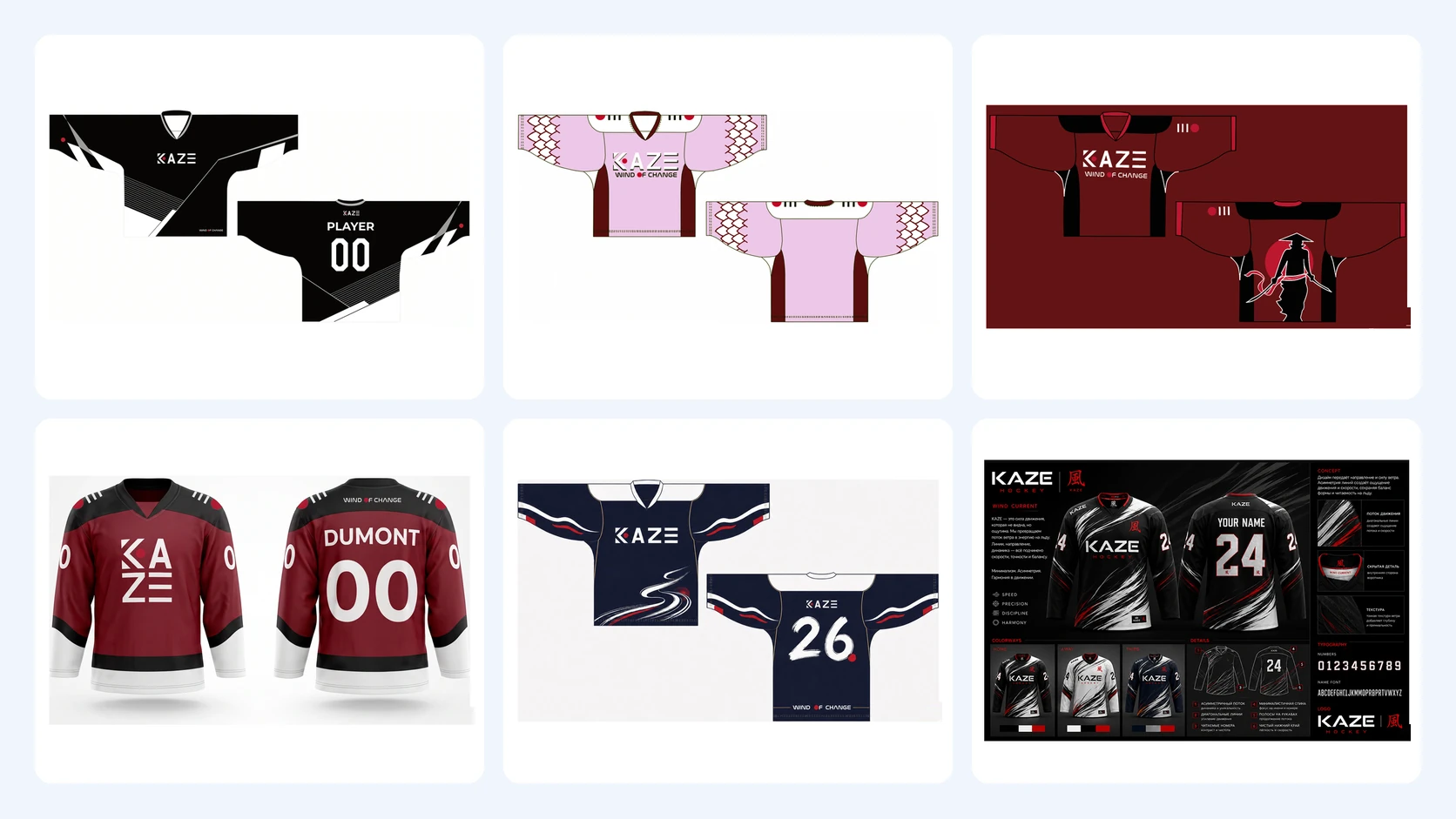
The Finalists' Works
Six solutions for a single brief. The order corresponds to the numbering in the vote.
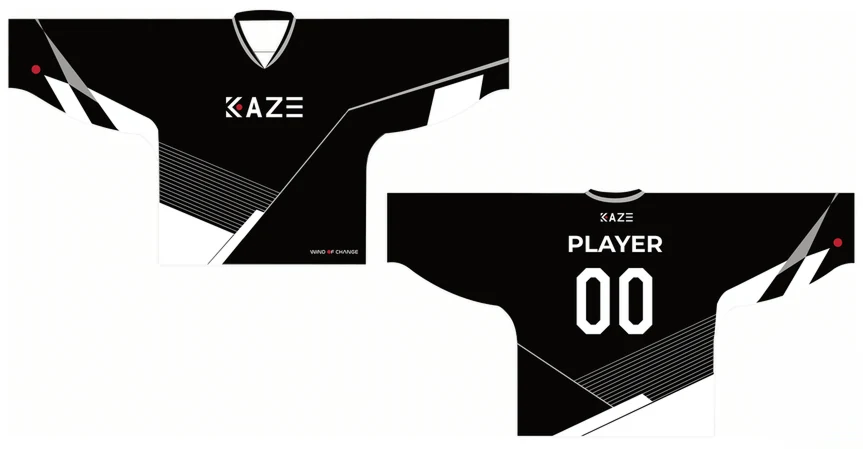

Black-and-white graphics without halftones. Diagonal planes and fine hatching indicate the direction of movement, while the number and text on the back remain large and legible from the stands.
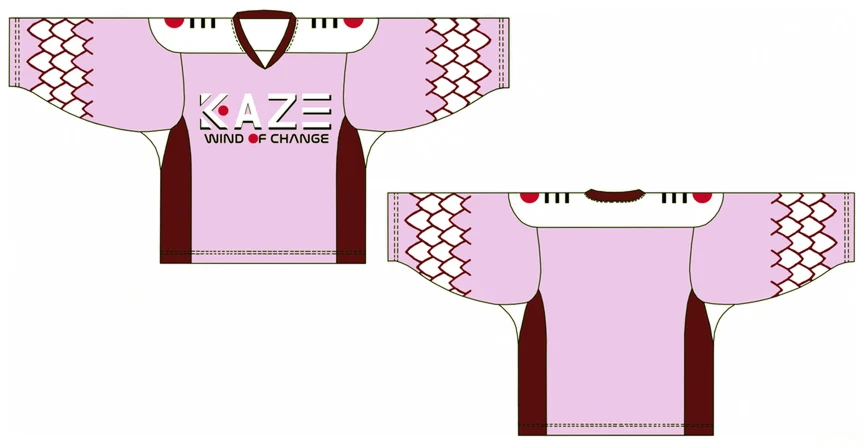

A shade of cherry blossom paired with a deep burgundy. The scale-like pattern on the sleeves evokes traditional Japanese ornamentation, while the shoulder panel with red circles ties the design together.
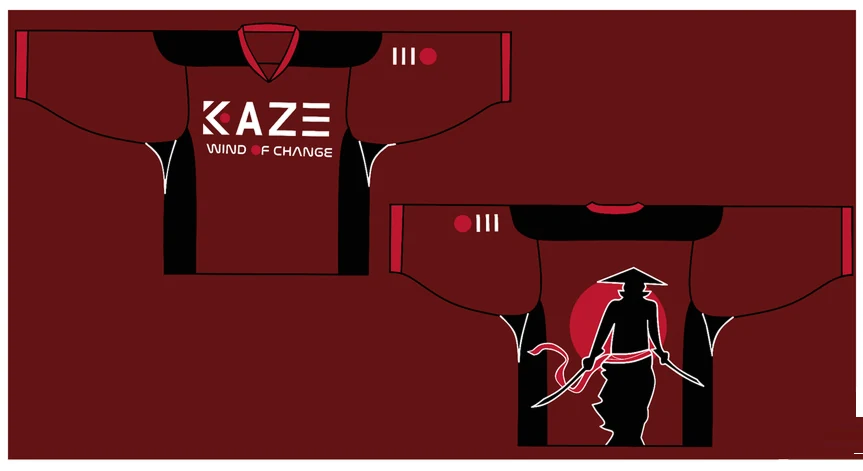

A burgundy case with black accents. On the back, a silhouette of a figure wearing a conical hat is set against a red sun; the belt strap echoes the theme of the wind.
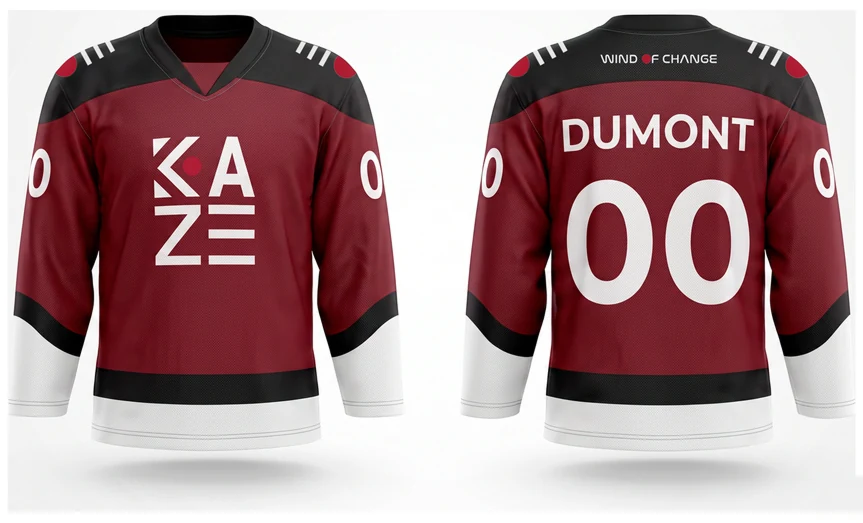

A classic hockey jersey design in burgundy, black, and white. The KAZE logo is presented as a large block; the design is immediately shown on a 3D mockup featuring the player’s number and last name.
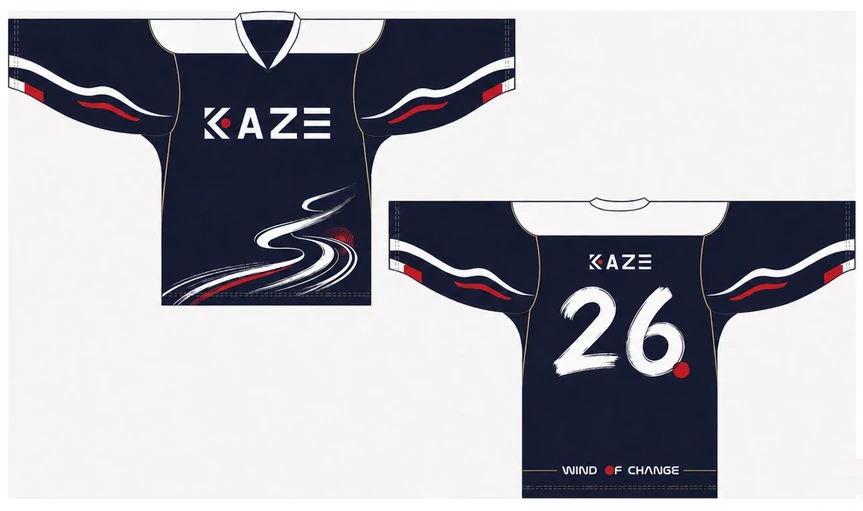

A dark blue background with white and red swirls that flow together into a single stream. The number is painted with a brush, so it looks handwritten rather than assembled from pre-made elements.
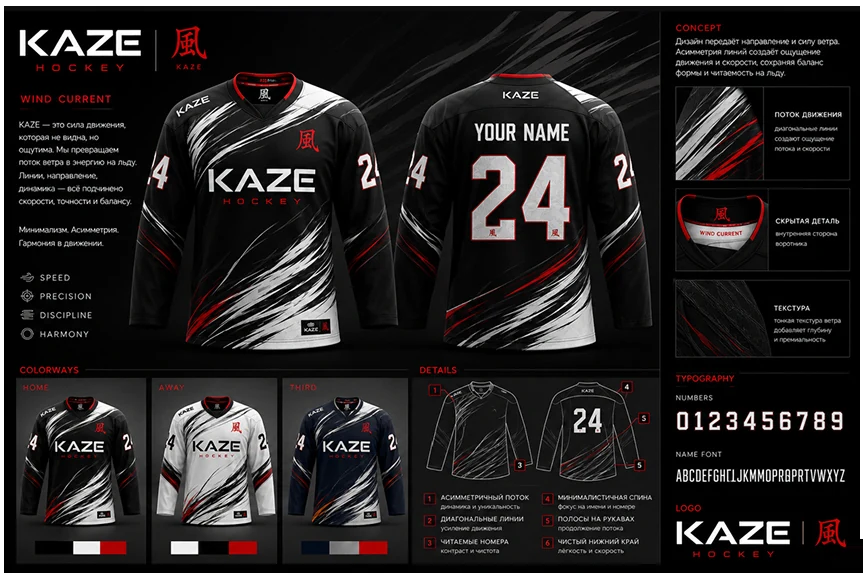

Not just a single mockup, but a complete presentation: the Wind Current concept, three colorways, typography for numbers and names, and detailed collar designs and textures.
Two Awards
The competition is intentionally divided into two independent categories, which more closely reflects how design is evaluated in real-world practice.
The overall winner is selected by the KAZE Hockey team. The winner's jersey is tailored according to his design.
The winner is determined by an open vote on the institute's Instagram page. The winner will receive a special prize from SIIL.
All contest participants receive prizes from the brand and the institute, regardless of the outcome of the vote.
How does this benefit students?
A design graduate’s portfolio typically consists of coursework: the topic is chosen by the student, there are no restrictions, and the work is graded by an instructor. An employer views such a project as an exercise.
Everything is different here. There’s an external client with their own brand book, there’s a deadline, there’s a rigid medium, and in the end, there’s a solution developed by someone else. It’s precisely this combination that turns the project into a case study you can showcase in a job interview.
In addition, each of the six authors gained experience in publicly defending their work: the work is made publicly available, discussed, compared with five other solutions to the same problem, and evaluated. For a designer, this is just as much a part of the profession as the layout itself.